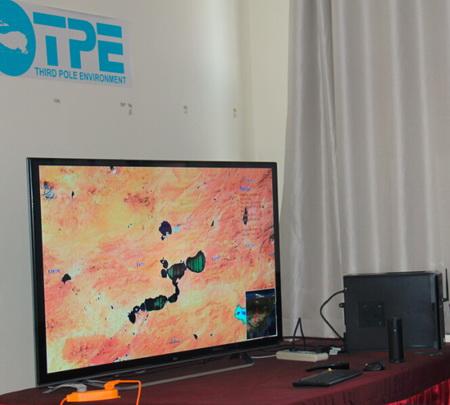
A SatSee System was installed in CAS Kathmandu Center on November 20, 2015 by the delegates from the Center’s
supporting institution, the Institute of Remote Sensing and Digital Earth (RADI), CAS. The SatSee System (also
known as Virtual Ground Station) will provide quicklook data service of China’s three satellites to Tribhuvan
University (TU). Once connected via internet, the system is capable of receiving near real-time, full resolution
satellite quicklook images. The system is expected to contribute to emergency monitoring such as flood, debris
flow, fire, and other natural disasters, and the ecosystem monitoring in Nepal.
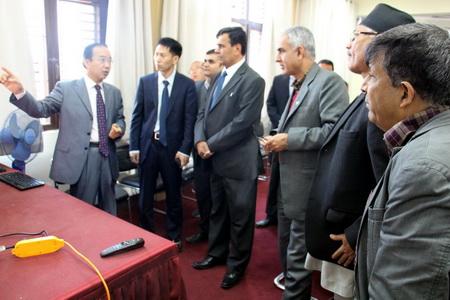
Invited by CAS Kathmandu Center and Tribhuvan University (TU), RADI’s delegates, led by Prof. LIU Jianbo, deputy
director of RADI, also attended a meeting with TU officials during the visit.
Prof. LIANG Eryuan, Executive Director of CAS Kathmandu Center, briefed the TU officials about the recent
progress and upcoming activities of the Center. Prof. LIU Jianbo introduced the main parameters and the
applications of the SatSee System. During the meeting, a MOU is signed between RADI and TU on cooperation in the
use of Satellite Quicklook data from China.
Prof. Tirtha Raj Khaniya, Vice-chancellor of TU, spoke highly of the achievements of CAS Kathmandu Center. He
mentioned the installation of the SatSee System will definitely improve TU’s scientific and educational levels
in remote sensing. He said TU would like to use the CAS Kathmandu center as a platform to extend its cooperation
with CAS.
Prof. Gunanidhi Nyaupane, Rector of TU, Prof. Chandra Mani Poudel, Registrar of TU, Prof. Lochan Prasad Devkota,
contact person of CAS Kathmandu Center and TU and staffs from CAS Kathmandu Center were also presented in the
meeting.